Imagine someone is looking for a provider for exactly what you offer. In the past, that person would have opened Google, typed a few search terms and clicked through the results. Today, a growing share of these people opens ChatGPT, Claude or Perplexity instead and simply asks a question. The AI answers with a few concrete names. Whether yours is among them depends on something most website owners have never checked: whether the AI could read your site at all.
That is what “AI-findable” means. This post explains what is behind it, without jargon, and why it is worth thinking about now rather than in two years.
What is changing right now
The way people search for things online is shifting. Not overnight, but clearly. Depending on the study, around a third of consumers now prefer to start their search with an AI tool rather than a classic search engine. In a business setting the effect is stronger still: among buyers of business software, roughly half now begin their research more often with an AI chatbot than with Google.
One thing matters here, and it is often misrepresented: Google is not dead. Classic search has not collapsed. What has happened is something else: a second search world has grown up next to Google. Total search volume has even increased, because many people now use both, sometimes Google, sometimes ChatGPT, often in the same research process. Anyone who wants to be found today has to appear in both worlds, not just one.
Most websites are optimised for the first world and not prepared for the second at all. That is exactly the gap.
Why an AI reads your site differently than a human
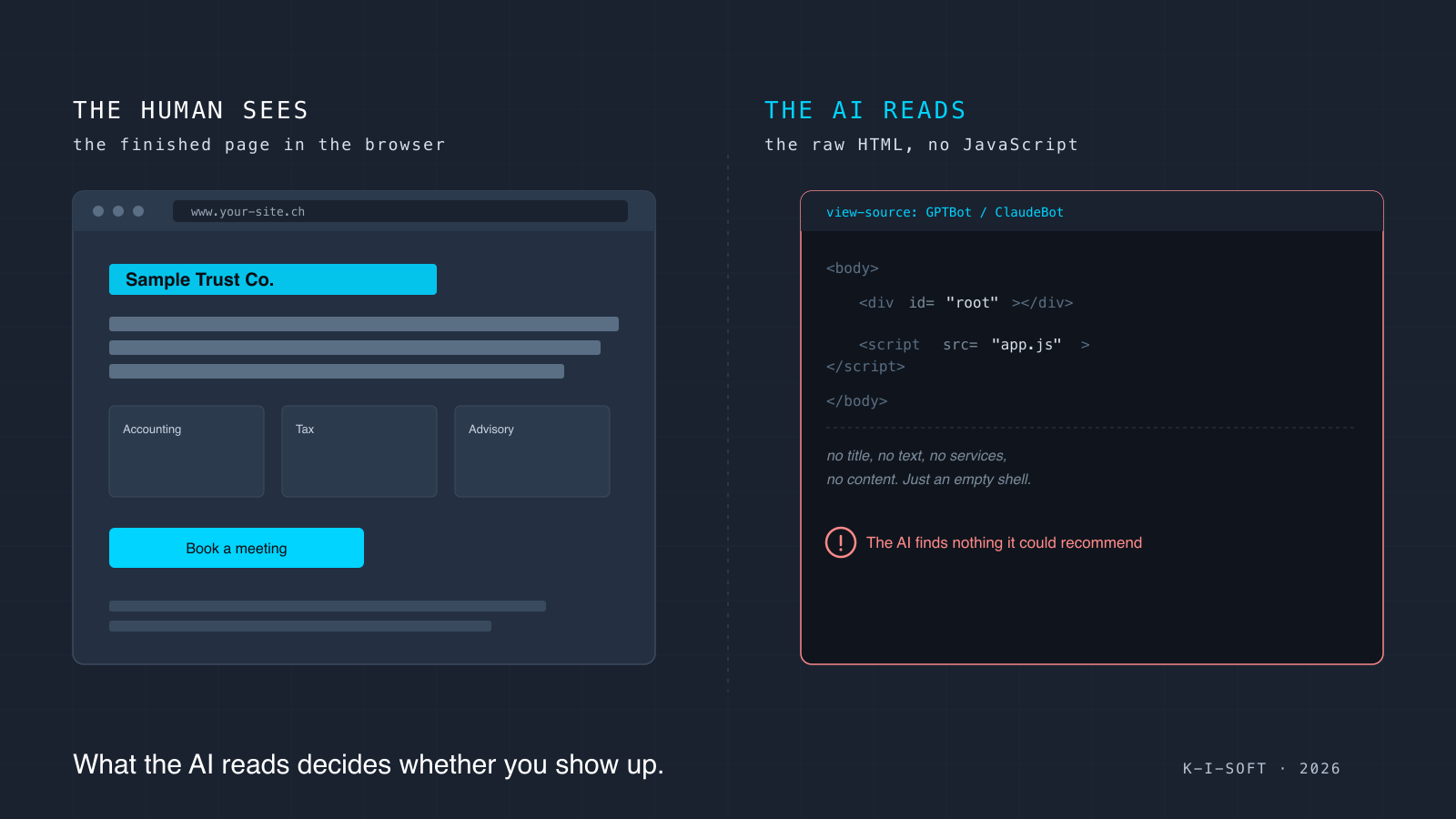
Here is the technical core, but in plain words. A human opens your website in a browser. The browser loads the page, runs program code in the background, assembles content, loads images, and in the end the human sees a finished page. That takes fractions of a second and works well.
An AI does not do that. The programs that collect content for ChatGPT, Claude or Perplexity are called crawlers. They load your page, but they do not run the program code in the background. They read only what is in the delivered document right away, in what is called the HTML. What only comes into being by running code in the browser afterwards, they do not see.
That has an uncomfortable consequence for many modern websites. A large number of sites today are built so that the actual content is only assembled in the browser. For the human visitor this is invisible, the page looks finished. For the AI, though, this page is largely empty. It finds a technical shell and barely any content. And what the AI cannot read, it cannot recommend in an answer either.
How to tell whether your own site is affected
There is a simple test anyone can do, with no technical knowledge at all. Open your website in the browser, right-click on an empty spot and choose “View page source”. A view opens with the raw code of your page. Search it (with Ctrl+F or Cmd+F) for a sentence you know is on your page, for example your service description.
If you find the sentence in the source, that is a good sign: your page delivers its content directly, and an AI can read it. If you find only code and references to program files, but not your actual text, then your page is probably largely invisible to AI crawlers. That is not the end of the world and it is fixable, but it is good to know.
What makes a page AI-findable
Three things decide whether a page appears in the AI world.
First, the content is in the delivered document directly, not only after code runs in the browser. Technically this means the page is generated server-side or statically, not assembled in the browser first. For the AI, the content is visible from the very first request.
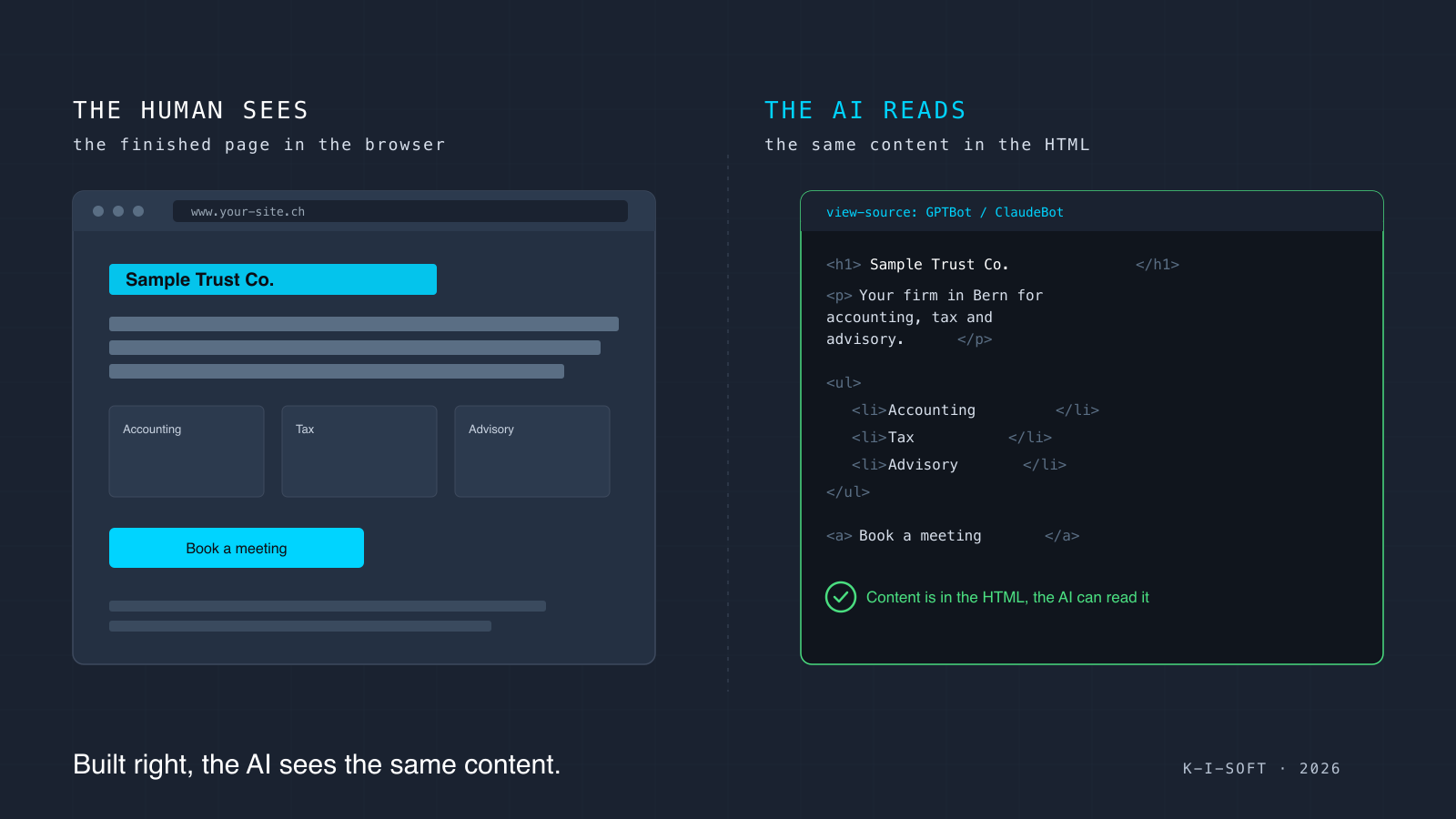
Second, the page is structured so that a machine understands what it is about. This includes clean markup with what experts call Schema.org, a kind of labelling that tells a machine: this is a company, this is a service, this is a location. A human sees it anyway, a machine needs the hint.
Third, and this is the honest limitation, nobody can guarantee that a particular AI names your site on a particular day in a particular answer. These systems are not steerable like a paid ad. What you can do is create the precondition that the AI can read and understand your site at all. Without that precondition a mention is ruled out, with it a mention becomes possible.
What you can verify instead of hope
Because nobody can guarantee mentions, the most honest thing you can do is make visible what actually happens. Each of these AI crawlers leaves a trace when it fetches a page. The server logs of a website record which crawler read which page and when. GPTBot from OpenAI, ClaudeBot from Anthropic, PerplexityBot and a few others.
This can be made visible on a dashboard. Instead of hoping the AI knows the page, you see in black and white that GPTBot fetched seventeen pages yesterday and ClaudeBot the home page. That is not proof of a concrete mention, but it is the verifiable first step: the AI has read the page. Everything else builds on that.
What you can do now
Three steps, depending on your situation.
If you have an existing website, do the source-code test from above. It costs two minutes and tells you whether your page is readable for AI in principle.
If you are unsure what the test shows, ask your website maintainer or your agency one simple question: “Is our page’s content delivered server-side, or only assembled in the browser?” The answer tells you where you stand.
If you are planning a new website anyway, AI findability belongs in the first planning round, not at the end. It is not an afterthought optimisation, but a decision about the foundation the site stands on.
Sources
- Eight Oh Two / Search Engine Land, 2026 AI and Search Behavior Study (share of consumers starting with AI tools): https://searchengineland.com/
- Graphite, “AI Is Much Bigger Than You Think”, March 2026 (growth of combined search volume, AI share): https://graphite.io/
- G2, B2B Buyer Behavior 2026 (AI use among business-software buyers): https://www.g2.com/
- Bain & Company, consumer search behaviour (share of search engine vs. chatbot as starting point): https://www.bain.com/
- Vercel, “The rise of the AI crawler” (AI crawlers run no JavaScript): https://vercel.com/blog/the-rise-of-the-ai-crawler
This post explains the concept behind K-I-Soft’s visibility offering. If you want to see which AI crawlers already fetch your own site today, the 30-minute call is the next step.