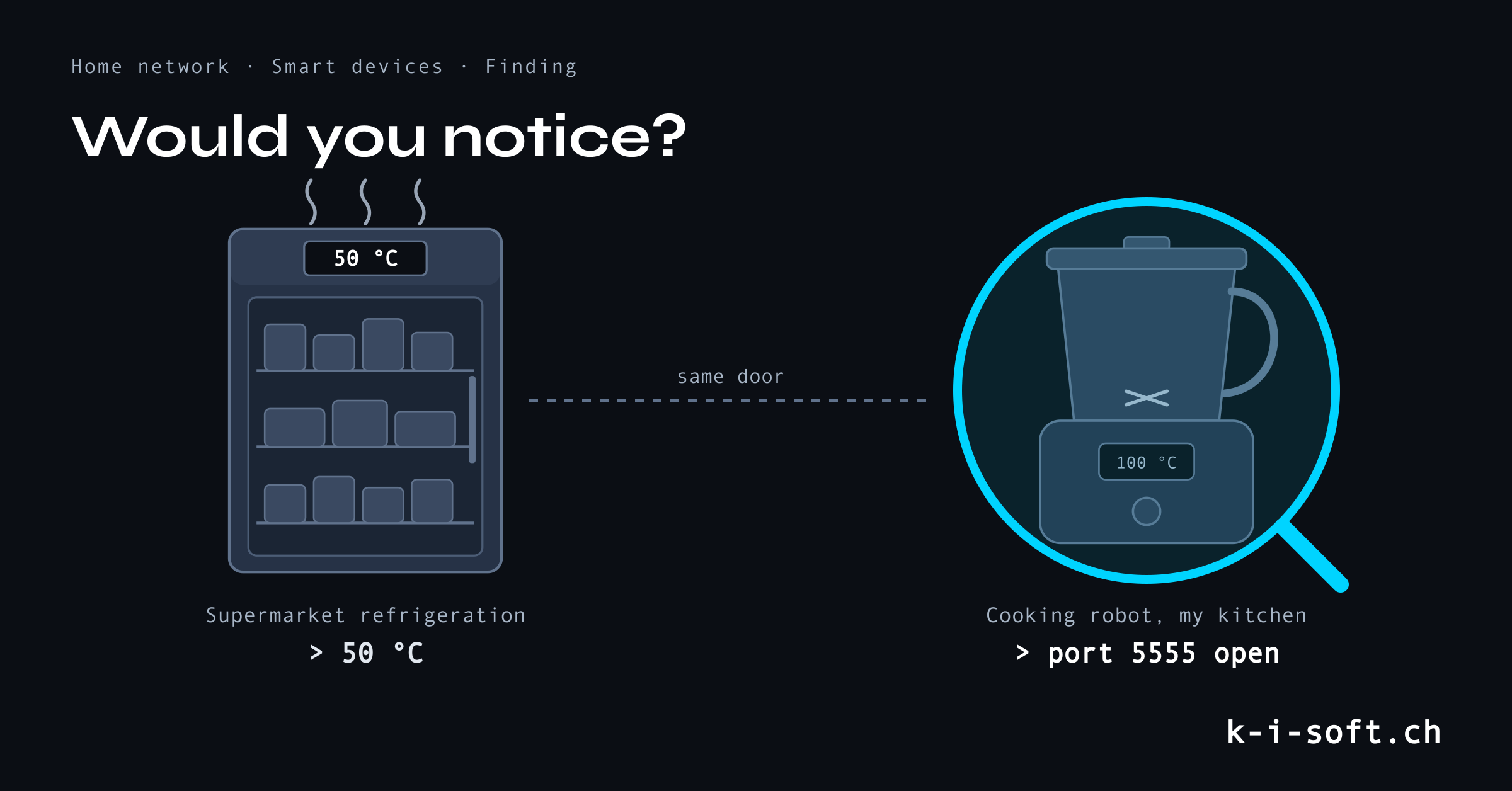
In early November, unknown attackers remotely heated up supermarket refrigeration systems in at least ten European countries, to as much as 50 degrees. In Köniz near Bern, a butcher’s meat spoiled and the price tags melted.
I read the news, nodded and thought this was about businesses with poorly maintained equipment. Then I took a look at my own network.
A device with a heater and a blade
In my kitchen there is a cooking robot from a Chinese manufacturer, bought new a few weeks ago. It weighs, stirs, chops, steams and cooks sous-vide. So it has a heating element and a blade, and it is on the Wi-Fi.
On this device, the maintenance port for developers was open, without a password. Anyone on my Wi-Fi could connect and immediately had a command line on the device. I tried it from my laptop, and it took seconds.
After that I could read the recipe database and the operating logs. The firmware was built at the end of December 2025, but underneath sits Android 7.1.2 with the April 2017 security patch level, in a developer build on top. From everything I saw, full control is one command away. And the same app drives the heater and the motor over a serial line.
I don’t know what protection the hardware itself has built in. I have not tried it, and I won’t.
When it is reachable from the internet
At my place nobody gets to the device from the internet, my router does not let unsolicited connections through. You cannot count on that everywhere, though. The device gets a public IPv6 address. Behind a router whose IPv6 firewall is switched off, the maintenance port is reachable from the whole internet, without a password.
That is exactly how the supermarket attacks work. Marc Ruef of Scip told Blick that the attackers often use default accounts or weak passwords. My robot had none at all.
The door I cannot close
I can close the open port on my own network. But there is a second door. The app contains the addresses of a cloud platform in China and a service that can install new apps without asking. That is how the device is built, and probably how it gets its updates.
At one of the affected stores in North Rhine-Westphalia, the operator says the attack came through the company that maintains the refrigeration remotely (ZDFheute). That is the same kind of door. The manufacturer decides about it, and I only see it from the outside.
Bought new, patched to 2017
A new device running an Android that has not received security updates for years is not an isolated case. In September 2024, Doctor Web found almost 1.3 million hijacked TV boxes in 197 countries (Doctor Web). One of the affected models reported exactly this Android 7.1.2, with the same build number NHG47K that my cooking robot shows. According to Doctor Web, budget manufacturers often ship old Android versions and sometimes even present them as newer ones.
In June 2025 the FBI warned about millions of cheap Android devices, mostly made in China, from TV boxes to digital picture frames. Some of them had the malware on board before they were even sold (FBI).
Nobody counts how many new devices are sold with such an old foundation. It is certainly not written on the box.
Why this bothers me more than the supermarket
Anyone who builds systems for the internet watches every open interface there. With a kitchen appliance hardly anyone does. You unpack it and type in the Wi-Fi password, and that is it.
The Swiss Federal Office for Cybersecurity also reports hacked home networks. Now I understand what that looks like. Nobody has to break in for it, the devices stand open and nobody looks.
What you can do today
Take fifteen minutes and write down what is on your network. TV, camera, printer, robot vacuum, anything with an app. For each device, ask yourself whether you know how the manufacturer reaches it.
Anything you don’t know goes on the guest network, which most routers already have built in. There it no longer sees your laptops and your data.
And if you run a business, ask the supplier of your refrigeration or your till how their remote maintenance is secured. If the words default password come up, you have your answer.
Where this leads
In the EU, the Cyber Resilience Act will hold manufacturers accountable from 11 December 2027: secure settings out of the box and security updates, as a rule for at least five years. An open maintenance port without a password is the opposite of that. That helps with devices placed on the market from then on. My robot and today’s refrigerated counter stay as they are.
Until then, my own network follows the same principle as every system I build: a device gets only the paths it really needs.
Something on your network is running right now that you have not looked at since you unpacked it. The question is whether you would notice if someone else did.
Sources: ZDFheute, 3 November 2026 (German); Blick, 7 November 2026 (German); Doctor Web, 12 September 2024; FBI, 5 June 2025.