03 // Who visits you
People used to recommend you. Now they ask the AI.
When someone asks ChatGPT for a provider like you, your name comes up or it doesn't. The audit tells you why, with documented prompts and log-based proof.
- 1'800CHF fixed price
- 3-5days to the findings
- 4models queried on the record
- 30days of crawler proof from the logs
Why can’t I find my company in ChatGPT?
Because the model finds nothing readable on your site, or because the facts about your company are too contradictory to be quoted. AI crawlers run no JavaScript at all. Vercel measured this across its own network in December 2024, where GPTBot alone made 569 million requests in a month (vercel.com/blog/the-rise-of-the-ai-crawler). If your content only appears in the browser, the crawler sees an empty shell, and what it cannot read it cannot recommend.
What the audit delivers
Three to five days, then the findings arrive in four parts:
- What the models say today. ChatGPT, Claude, Perplexity and Google AI, queried with fixed prompts that are printed in the report. You see the answers verbatim, including the places where a competitor is named and you are not. Because the prompts are documented, the measurement can be repeated later.
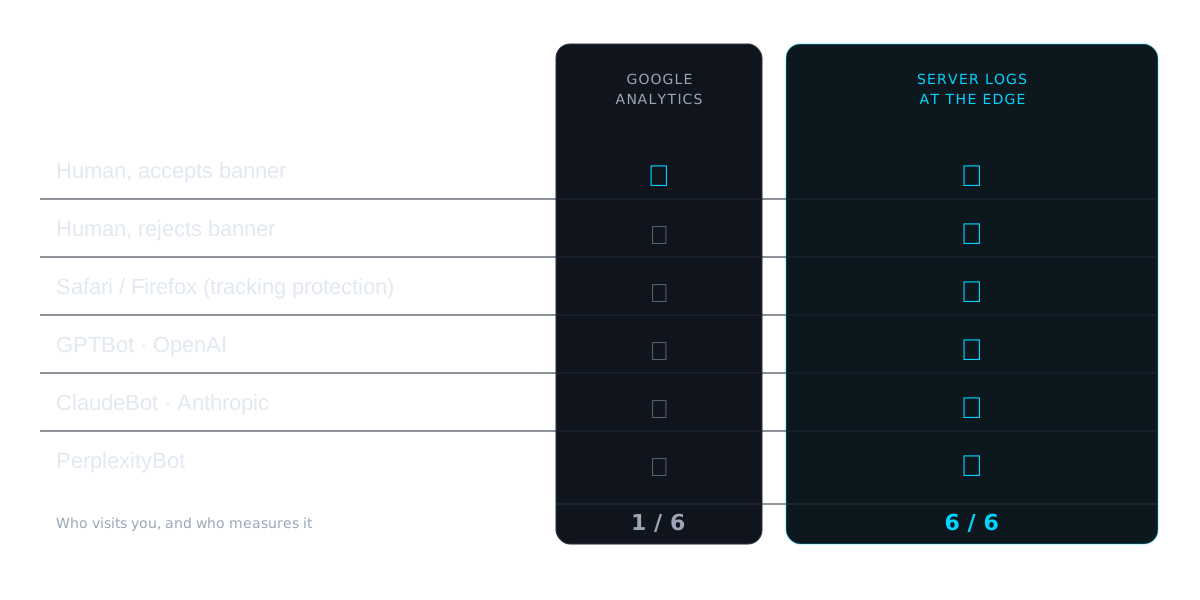
- Who really crawls you. From the server logs of the last 30 days: which AI crawler fetched which page and when, GPTBot, ClaudeBot, PerplexityBot and the rest. That is proof, not an estimate, and it appears in no analytics interface.
- What is structurally missing. Whether your content sits in the delivered HTML, whether there is a clean Organization entry, whether name, address and details line up across sources, and whether your pages answer questions in a way a model can quote a paragraph from.
- What to do about it. A prioritised list of measures, ranked by impact and effort, that you can act on internally, with another partner, or with us.
What a prompt-only check does not show
A prompt check shows what a model answers about you today. It does not show why. Whether an AI crawler read your site at all, when it last came, which pages it fetched and what your server answered, is only in the server logs. That is why both parts belong in the same audit.
The logs show causes no model answer reveals. On a client site we checked in June 2026, a browser, Googlebot and GPTBot were served the page, while ClaudeBot got an error. Claude could not know the company at all, whatever was on the page. In other cases the crawler fetches the page and finds an empty JavaScript shell inside, or it simply never comes.
On top of that comes a measurement error almost every analysis makes. Anyone can set the identifier in the user agent, any program can call itself GPTBot. We therefore check every request against the providers’ published address ranges and count only what demonstrably came from there, the verified crawl. Across eleven sites we measured, a third of the requests with a crawler identifier were fake in the window from 11 August to 10 September 2026. On scmc.ch, 7,118 requests carried a crawler identifier, and 344 of them were genuine.
Why Google Analytics does not show this
Google Analytics only starts counting after someone has accepted the cookie banner and the browser has run JavaScript. That does not apply to a growing share of your human visitors, and it never applies to AI crawlers.
With a compliant banner, only about half of people in German-speaking Europe opt in. That figure comes from a review of 26 European banner studies and from the Advance Metrics cookie behaviour study, which compares Germany and Switzerland. Safari and Firefox block tracking out of the box. The reported number is therefore not a measurement but a lower bound. With a compliant banner and roughly 30 percent Apple share, real traffic runs two to three times higher, derived in our article Half your visitors never show up in your stats, which lists every source. And not a single AI crawler shows up in it. That is exactly why the audit works from the server logs and not from analytics.
Proof, not promises
We promise no rankings and no citations. Nobody can do that honestly, because the decision is made inside the model and not by us. What we deliver is the precondition, and the proof that it holds.
This is exactly how it runs in production. SCMC.ch is live, served statically and measured server-side. Quartiero, our own product, has been running in AWS Zurich since July 2026. You then see not an estimated number but which crawler read which page and when.
What comes next
Three paths, all optional:
Implementation at a fixed price. We implement the measures from the findings, quoted by scope, on the site you already have.
A move, if the build itself is the problem. If the findings show a JavaScript shell or a WordPress site you no longer want to maintain, we move it to a static site in AWS Zurich: WordPress to AWS, CHF 4’500 fixed price for up to 15 pages. If the site lacks the structure people find you through, meaning location pages, project pages and machine-readable credentials, we rebuild it: Built to be found, CHF 12’000 fixed price for up to 20 pages. If you commission the rebuild within three months, the audit is credited in full. For a grown Java application it is a migration to AWS at a day rate of CHF 1’600.
Ongoing measurement, in two monthly packages. Both include operating the site, so they apply to a site we build or take over. Measure costs CHF 390 per month, for at least three months: operation, checked updates, your own login to Munot with the visitor and AI crawler statistics from the server logs, which you can look into whenever you want, and a monthly report by email. Visibility costs CHF 1’200 per month, for at least six months: everything in Measure, plus the same ten customer questions put to ChatGPT, Perplexity and Gemini each month, a list of the changes that would help most, a quarterly audit and two hours of implementation per month. What both contain in detail: Measure and Visibility. If you only need operation without measurement, for instance after a move away from WordPress, take the Operation package for CHF 240 per month, with the AWS bill up to CHF 30 and one hour of corrections. Other Swiss providers charge from CHF 500, mostly between CHF 1’490 and 1’900 per month for ongoing AI visibility, surveyed in October 2026.
Why work with us
- You work directly with the senior architect who runs the audit. No account manager handing the work to a junior.
- 30 years of software engineering across four countries stand behind every decision. We ship architecture rather than just talk about it.
- In the first call we tell you honestly whether this is even a thing for you. If your name already comes up, we say so.
- We are based in Bern, your data sits in AWS Zurich, FADP- and GDPR-compliant. Fluent German and English, with an understanding of the Swiss business context.
Common questions
Why can't I find my company in ChatGPT?
In most cases because the model finds nothing readable on your site. AI crawlers run no JavaScript at all. Vercel measured this across its own network in December 2024, where GPTBot alone made 569 million requests in a month (vercel.com/blog/the-rise-of-the-ai-crawler). If your content only appears after rendering in the browser, the crawler sees an empty shell. The second common reason is missing or contradictory facts about the company, meaning no clean Organization entry and diverging names and addresses across sources.
Which providers in Switzerland analyse a company's AI visibility?
In autumn 2026 we looked at nine Swiss providers that offer AI visibility. None of them advertises proof from the server logs. K-I-Soft in Bern checks both: what ChatGPT, Claude, Perplexity and Google AI say about your company, and which AI crawler actually read your site, matched against the providers' published address ranges. The audit costs CHF 1'800 at a fixed price and takes three to five days. If it shows that your site is empty for crawlers, we move it on request.
How do I measure AI visibility?
What is measurable is who fetches your site, not whether you get mentioned. We read the server logs before banner and JavaScript and prove which AI crawler read which page over the last 30 days. On top of that we document, using fixed prompts, what ChatGPT, Claude, Perplexity and Google AI say about your company today, so you have a baseline to compare against later.
What does the audit show that a prompt-only check does not?
A prompt check shows what a model answers today, but not why. Whether an AI crawler read your site at all, when it last came, which pages it fetched and what your server answered, is only in the server logs. We also check every request against the providers' published address ranges, because the identifier in the user agent can be set freely. Across eleven sites we measured in late summer 2026, a third of the requests with a crawler identifier were fake, on one of them 95 percent. Without that check you count fakes as visits from AI.
What does an AI visibility audit cost?
CHF 1'800 as a fixed price for three to five days. That covers the documented model queries, the crawler proof from the logs, the structural review of schema, entity and data consistency, and a prioritised list of measures. Implementation is separate and quoted on its own.
How do I get found in ChatGPT?
The precondition is that your content already sits in the delivered HTML and that the facts about your company are stored machine-readably. Both can be established and verified. Nobody can guarantee a mention, that is decided by the model in the end. We create the precondition and make it verifiable, and no one honest promises more.
Do I have to have my website rebuilt for this?
No. The audit runs on the site you have, including WordPress. Part of the measures can then be implemented in almost any system. Only if the findings show that your content fundamentally only appears in the browser is the build itself the problem, and we will say so plainly.
What does ongoing monitoring cost?
There are two monthly packages, both including the operation of a site we build or take over. Measure costs CHF 390 per month, for at least three months: operation, checked updates, your own login to Munot with the visitor and AI crawler statistics from the server logs, and a monthly report by email. Visibility costs CHF 1'200 per month, for at least six months: everything in Measure, plus the same ten customer questions put to ChatGPT, Perplexity and Gemini each month, a list of the changes that would help most, a quarterly audit and two hours of implementation per month. If you only need operation without measurement, for instance after a move away from WordPress, take the Operation package for CHF 240 per month, with the AWS bill up to CHF 30 and one hour of corrections. Other Swiss providers charge from CHF 500, mostly between CHF 1'490 and 1'900 per month for ongoing AI visibility, surveyed in October 2026.
Want to know what ChatGPT says about your company today?
In a 30-minute call we ask two or three models about your sector live and see whether your name comes up. If it does, we say so and you save the CHF 1'800.